
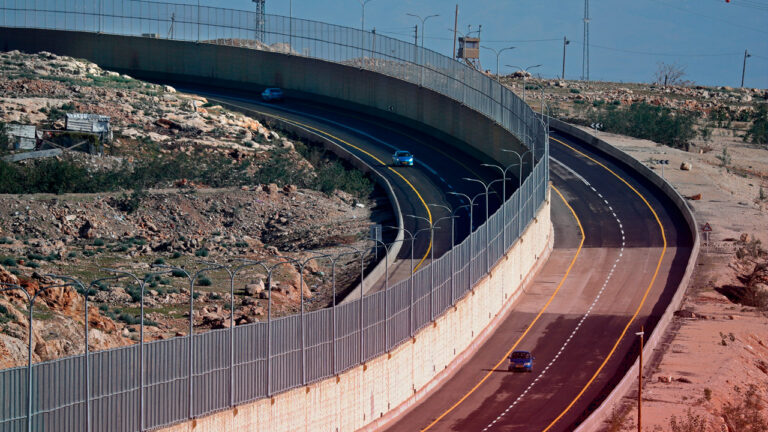
Explore the origins and impact of the West Bank barrier, its role in security, its effects on Palestinian life, and the broader debates it sparks in the Israeli-Palestinian conflict.
Essential Questions
- How does the West Bank barrier shape the daily lives and perspectives of both Israelis and Palestinians?
- How have historical events influenced the debate over "land for peace" in the Israeli-Palestinian conflict?
- What role does empathy play in discussions about the West Bank barrier and the broader Israeli-Palestinian conflict?
Big Ideas
- Impact of the Wall: The West Bank barrier’s construction had diverse and significant effects on the daily lives and perspectives of Israelis and Palestinians.
- Land for Peace: The "land for peace" concept is central to the Israeli-Palestinian conflict, with complex arguments and historical influences.
- Empathy in Conflict: Exploring empathy is essential when discussing the wall and the broader conflict, fostering a deeper understanding of different perspectives.
The separation barrier between the West Bank and western Israel, referred to by some as the security barrier and others as the Apartheid Wall, remains a deeply contested issue within both Israeli and Palestinian societies. For some, it is viewed as a necessary measure to protect Israeli citizens. For others, it is seen as a tool that enforces an unequal system and restricts Palestinian movement. And for many, it is a visual reminder of the ongoing failure of the peace process.
This resource explores the history, motivations, and consequences of the West Bank barrier, examining a range of perspectives on its purpose and impact. Through historical analysis, firsthand accounts, and relevant data, students will develop a more nuanced understanding of the complex forces that drive the conflict and policy decisions in the region. By engaging with this topic, students will strengthen their ability to critically assess multiple viewpoints, understand the relationship between security and human rights, and reflect on the broader implications of walls and borders in conflict zones worldwide.
Note: This video was created before the October 7 attacks on Israel and the outbreak of the Gaza War.
Discussion Questions
- Land for Peace: The idea of “land for peace” has been a central concept in the Israeli-Palestinian conflict. Some argue that exchanging land for peace can lead to a resolution, while others believe it poses significant challenges.
- What are the key arguments for and against the “land for peace” approach in the Israeli-Palestinian conflict, and how might historical events and differing perspectives influence these arguments?
- How would you weigh the benefits and drawbacks of this approach in seeking a long-lasting solution to the conflict?
- Security vs. Human Rights: Governments often impose restrictions in the name of security, especially during times of conflict. While these measures may protect some civilians, they can also limit freedoms and create hardships for affected communities.
- How do governments decide when security concerns justify limiting personal freedoms?
- Can a balance be struck, or does one always come at the cost of the other?
- Can you think of an example in your country when security concerns limited personal freedoms? Could a balance have been struck in that instance?
Learning Activities
- Words Matter: Draw a chart on the board comparing the terms “security fence” and “apartheid wall.” Ask students to list what comes to mind when they hear each term, and to give more than one answer. Then, debrief with your students:
- How do the different terms used for the barrier (e.g., “security barrier” vs. “apartheid wall”) shape the narrative, and how do those narratives compare with the historical information presented in the video? In what ways can we reconcile the narratives implied by each term with the historical realities?
- Is one narrative more “correct” than the other? Does each side place more emphasis on different points?
- What narrative does each name convey, and how does the historical accuracy of each perspective hold up?
- Training our Empathy Muscles: Play this powerful animated video about empathy by Dr. Brené Brown. Use it as a springboard to discuss empathy:
- How is it different from sympathy? What is so powerful about it? Why is it hard to achieve? How can we flex our “empathy muscle”?
- What role can empathy play when discussing the Israeli-Palestinian conflict, specifically concerning the building of the barrier in the West Bank?
- The Anti-Defamation League (ADL), “The Security Barrier”
- Goodman (2018), “Eight Ways to Shrink the Israeli-Palestinian Conflict”
[This article discusses steps Israel can take to improve Palestinian quality of life in the West Bank, thereby shrinking the conflict.] - Backmann (2010), A Wall in Palestine
- Shoman (2019), “Israeli Perspective on the Security Fence”
- B’tselem (2017), “The Separation Barrier”
- Goodman (2018), Catch-67: The Left, the Right, and the Legacy of the Six-Day
[Catch-67 by Micah Goodman provides a nuanced analysis of the Israeli-Palestinian conflict, highlighting the paradoxes and debates surrounding the wall and broader territorial disputes.