
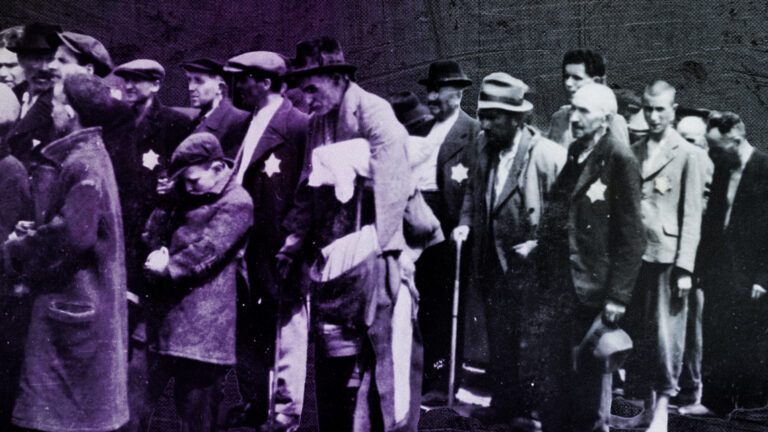
What is the Holocaust?

Resource: Video

Trace how centuries of vibrant Jewish life in Europe were systematically destroyed by Nazi Germany and explore why understanding the Holocaust still matters today.

Essential Questions

  • How did the Holocaust escalate from discriminatory laws to systematic murder in one of Europe's most educated societies?
  • What economic, political, and social barriers prevented European Jews from escaping, and how did collaboration enable the genocide perpetrated by the Nazis? 
  • How did Jewish individuals and communities resist the Holocaust, both through armed resistance and acts of spiritual and cultural defiance?

Big Ideas

  1. Systematic Escalation: The Holocaust progressed through deliberate stages–from discriminatory laws (1933), to state-sponsored violence (1938), to ghettoization (1939-41), and finally to systematic murder in Nazi killing centers (1942-1945)
  2. Complicity, Collaboration, and Closed Borders: The Holocaust required widespread collaboration from governments and individuals across Europe while international indifference and closed borders trapped Jews and made escape nearly impossible. 
  3. Resistance and Humanity: Despite impossible odds, Jewish individuals resisted through armed uprisings, spiritual defiance, preservation of memory, and daily acts of survival–asserting their humanity in the face of systematic annihilation.

The Holocaust was the systematic, state-sponsored persecution and murder of six million Jews by Nazi Germany and its collaborators between 1933 and 1945. This resource introduces students to how a modern, cultured society descended into genocide, why escape was nearly impossible, and how Jewish communities and individuals resisted in both spiritual and armed ways.

This video and the accompanying curriculum guides students through the chronological unfolding of the Holocaust: from the isolation of Jews in 1930s Germany, through the implementation of the “Final Solution”, to liberation and its aftermath. By understanding the Holocaust, students confront fundamental questions about human nature, the dangers of unchecked hatred and propaganda, the consequences of indifference, and the resilience of the human spirit.

How to use the guide
This guide is designed to support student engagement with the video “What is the Holocaust?” and can be adapted for various classroom settings. The curriculum provides multiple entry points: pre-learning activities to activate prior knowledge, discussion questions that encourage critical thinking and empathy, and summative activities that allow students to demonstrate understanding in diverse ways.

Discussion Questions

  1. Humanity as Resistance: What does resistance mean in the context of the Holocaust? Why would teaching children or keeping a diary be acts of resistance? How does each form of resistance assert humanity against dehumanization? Why resist when survival or victory seems impossible? How do we honor both those who resisted and those who couldn’t?
  2. Loss Beyond the Numbers: When you consider what was destroyed: individual lives, whole communities , languages and cultures, knowledge and traditions, future generations , and the basic sense of safety and belonging–how do we comprehend numbers like six million while honoring each individual person? What does it mean for an entire world—not just people, but communities, languages, traditions, knowledge—to be lost? When a community that existed for centuries is nearly completely destroyed, what’s lost that can never be rebuilt?

Learning Activities

  1. Jewish Life in the Ghettos Case Study
    The video describes how Jews were forced into ghettos in cities such as Warsaw, Lodz, and Krakow, where “overcrowding, hunger, and disease claimed thousands of lives even before deportations began”. In small groups, ask students to create a 5-7 minute presentation on daily life and resistance in different ghettos. Students should examine:

    • Population, size, establishment and liquidation timeline of each ghetto
    • Living conditions
    • Examples of spiritual/cultural and armed resistance
    • 2-3 examples of individual stories illustrating life in the ghetto
  2. Interactive Timeline Exhibition
    Using 10-15 events from the timeline, students will create a digital “exhibit” that focuses on pairing events from the timeline with primary sources such as photographs, artifacts, newspapers, or diaries. Students should explain how their artifact connects to their event and focus on highlighting individual stories whenever possible. Students should use the following databases and resources to gather artifacts:


Download Educator’s Guide

All resources are available in PDF format for offline use in all settings.

Your download will open in a new window.

See Transcript

Prepare your lesson with ease using the full transcript.

Download Video Source Sheet

Your download will open in a new window.

Get Teaching Tips

Watch this brief webinar for practical strategies to engage your students.

Share link with students

STUDENT SIGN IN not required

https://youtu.be/b1ML5H5eJ5I

Unlock these resources with a free account

Sign up for a free account to access resources that help students explore diverse perspectives and gain a deeper understanding of complex issues.

GET STARTED FOR FREE

Already have an account?