
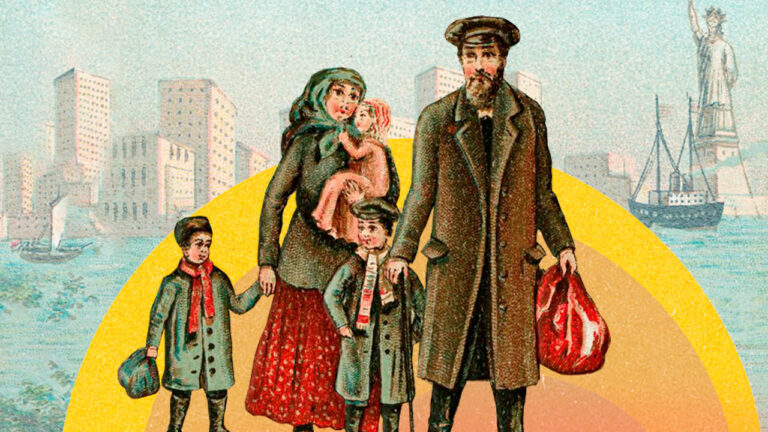
A Jewish-American Tale: The Early 20th Century

Resource: Video

Content Area:

Explore the complexities of Jewish identity in early 20th century America, including the impact of the Holocaust and the significant contributions of Jewish Americans.

Essential Questions

  • How did American Jews balance the desire to assimilate with the need to preserve their identity?
  • In what ways did antisemitism and exclusion shape Jewish American institutions and culture?
  • What does the American Jewish experience reveal about the challenges of belonging in a diverse but exclusionary society?

Big Ideas

  1. Belonging and Boundaries: American Jews have long navigated the tension between embracing American ideals and confronting the barriers that excluded them.
  2. Shaping Identity Through Struggle: Moments of pressure and prejudice pushed American Jews to rethink and reshape what it means to be both Jewish and American.
  3. Community, Conscience, and Complexity: Jewish American life has been shaped by both the desire to fit in and the responsibility to speak out—even when those values collide.

Grade Level: 6-12

Subject(s)

  • U.S. History
  • Social Studies
  • English Language Arts

Rationale/Teacher Notes

This resource examines Jewish American life in the early 20th century, focusing on the tension between assimilation and identity preservation and the impact of discrimination and exclusion. Students explore how American Jews navigated belonging in a society that both welcomed and rejected them. This resource is designed to serve as essential context before:

  • Teaching about American immigration and the contributions of immigrant communities
  • Exploring immigration restriction in U.S. history
  • Teaching about the Holocaust and America’s response to the refugee crisis
  • Discussing assimilation and identity preservation in immigrant communities


  1. Pre-Teaching Vocabulary: Introduce students to key terms they will encounter in the video. This can be done as a think-pair-share activity, part of a warm-up/bellringer, or as vocabulary cards.

    Key terms:

    • Acculturation – adopting practices of the dominant culture while retaining connection to one’s culture of origin
    • “Americanization” – efforts to make immigrants adopt American language, customs, and values
    • Assimilation – the process by which a minority group comes to resemble the majority culture
    • Pogrom – violent mob attacks against Jews, especially in Russia and Eastern Europe
    • Quota – a limit on the number of people allowed (e.g., Jewish students at universities, immigrants from certain countries)
    • Restrictive covenant – legal agreements that prohibited Jews (or other groups) from buying or renting property in certain areas
    • Johnson-Reed Act – 1924 law that severely restricted immigration to the U.S., especially from Eastern and Southern Europe
    • Refugee – a person fleeing persecution or danger in their home country
    • Parallel institutions – organizations created by excluded groups to provide services they were denied elsewhere
    • Xenophobia – fear or hatred of foreigners or immigrants
  2. Role playing: Many of the first-generation Jewish Americans had much in conflict with their Jewish immigrant parents, as they differed in their Americanism, religiosity, and social status. Ask your students to list possible points of conflicts between the children of immigrants and their parents. Then, have your students role play two different conversations between Jewish teenagers and their immigrant parents. Afterward, discuss ways immigrant families can navigate the differences between the different generations. Invite students to share personal stories if they are comfortable.
    • Scenario #1: The parents want their child to continue to attend synagogue on the Jewish Sabbath on Saturday, while the child would rather play on their school’s baseball team and attend practice on Saturdays with their friends.
    • Scenario #2: The child is embarrassed by the broken English of their parents and wants them to stop speaking Yiddish (a Jewish-European language) at home and in public. The parents are hurt that their child is embarrassed by them, especially when they work so hard to provide them with a better life.
  3. Jewish Life in America Today: Ask students to make two lists describing Jewish life in America as described in the video and Jewish life in America today. Compare and contrast the two lists. What has and hasn’t changed? (Examples could include antisemitism, acceptance of Jews in American institutions, and religious affiliation.) For students less familiar with the Jewish community, consider: How do you think a minority group might experience both progress and ongoing challenges in a country like the U.S.?
  1. Balancing American and Religious, Ethnic, or Other National Identities: What does it mean to be both American and Jewish? Show your students this political cartoon published in 1899 entitled “The Hyphenated American.” Ask the students:
    • Why would some people call themselves a Jewish-American and others call themselves an American Jew? What is the distinction between those two terms? If you identify with both an American identity and another heritage, how do you prioritize them? Why might someone choose to emphasize one identity over another in different situations?
    • How do you balance the intersections of your many identities? Encourage students to share personal stories.
  2. The Names We Carry: Read this article reviewing Kirsten Fermaglich’s book, A Rosenberg by Any Other Name: A History of Jewish Name Changes in America. Fermaglich’s study reveals that many Jewish families legally changed their names in the 20th century to avoid discrimination.
    • Given this context, how would you feel about having a distinctly Jewish first name in a predominantly non-Jewish environment? Would you consider changing it to something more secular to fit in better with your peers and the greater society? Why or why not?
    • Share a time when you or someone you know had to make a decision about using a name that would stand out in society. Was it challenging or easy to do? How did it impact your or their sense of identity and belonging?
  1. At the end of the 19th century, two million Jews arrived in the United States from which country?
    • France
    • Morocco
    • Russia
    • Lithuania
  2. What was the name of the law passed by Congress that severely restricted immigration to the United States in 1924?
    • The Muslim Ban
    • The Johnson-Reed Act
    • The Immigration Limits Act
    • Executive Order #31
  3. What was one of the results of public schools trying to “Americanize” Jewish children of immigrants?
    • Many Jewish students rejected aspects of their Jewish identity and hid their heritage.
    • Jewish students switched from public schools to Jewish day schools.
    • Jewish immigrants chose to move to different countries.
    • Many Jewish students proudly showed off their Judaism and heritage.
  4. True or False: Jews were fully accepted into middle-class America and could join universities and buy homes in the suburbs.
    • True
    • False
  5. Which two Jewish organizations protested and organized rescue efforts for European Jews persecuted by the Nazis?
    • Joint Distribution Committee
    • Va’ad ha-Hatzalah
    • American Jewish Committee
    • Orthodox Union

Share link with students

STUDENT SIGN IN not required

https://www.youtube.com/watch?v=c9W7GnbrOzw

Download Educator’s Guide

All resources are available in PDF format for offline use in all settings.

Your download will open in a new window.

Download Lesson Plan

Use our ready-made lesson plan.
Your download will open in a new window.

See Transcript

Prepare your lesson with ease using the full transcript.

Download Video Source Sheet

Your download will open in a new window.

EdPuzzle

Test your students’ knowledge with an engaging EdPuzzle on this topic. (The link will open in a new window)

Unlock these resources with a free account

Sign up for a free account to access resources that help students explore diverse perspectives and gain a deeper understanding of complex issues.

GET STARTED FOR FREE

Already have an account?